
The Elements: Fire & Air
Insight & Diffusion
Part I
The Elements and the Energetic Polarities
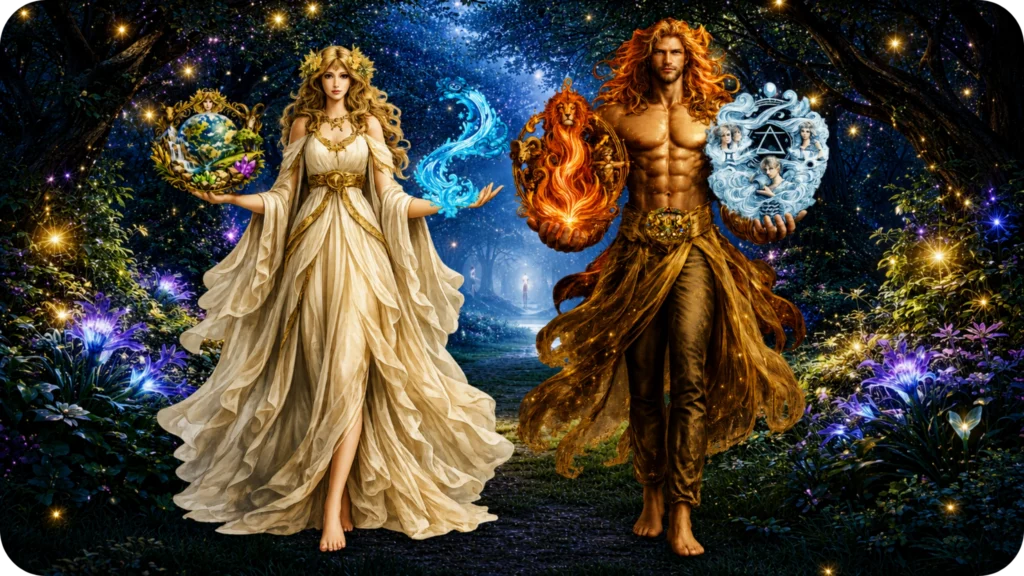
The elements are one of the fundamental, if not the most fundamental, components of astrology in every natal chart. They shape a person’s temperament, which tends to remain relatively stable throughout their life. There are four elements in Western astrology – fire, earth, air, and water. Traditionally, they form two complementary pairs: fire and air, and earth and water. They can also be understood in terms of two polarities – masculine and feminine, or respectively yang and yin, or extroverted and introverted.
- Masculine elements – fire and air – express yang energy: outward-directed, active, and expressive. They are associated with extroversion, engagement with the external world, initiative, spontaneity, enthusiasm, and quicker reactions.
- Feminine elements – earth and water – express yin energy: receptive and more inward-oriented. This does not mean a lack of sociability or expressiveness – introversion is characterized more by reserve, self-reflection and a tendency to draw energy from within. Especially with earth signs, outward expressiveness may be less pronounced, as efficiency and the end result are often more important to them.
Even within these two polarities, one element is more strongly aligned with the polarity itself: fire is the more yang of the two yang elements, while earth is the more yin of the two yin elements.
The Elements and Temperament
In astrology, the distribution of the elements is used to determine temperament, i.e. temperament is “the combination of relatively stable individual psychological characteristics that shape the way a person’s mental activity unfolds and remain relatively consistent across different motivations, circumstances, and goals.” (Wikipedia, “Temperament,” my translation from the Bulgarian). It is connected with the aspect of personality concerned with “emotional dispositions, reactions, and their speed and intensity”. (Encyclopaedia Britannica, “Temperament”). Thus, the elements provide information not simply about what a person does, but about the way their psychic energy moves, the way they experience it and the way they express it.
The humoral theory of the ancient Greek physician Galen (2nd century AD), developed on the basis of Hippocrates’ earlier physiological theory of the four bodily fluids (humors)—blood, phlegm, black bile, and yellow bile—classifies people into four types according to the humor that predominates in their bodies:
- Sanguines – fast, lively, optimistic, and sociable, but with more changeable reactions.
- Cholerics – energetic, ambitious, self-confident, but often impulsive and irritable.
- Phlegmatics – calm, balanced, patient, and slow, but sometimes passive.
- Melancholics – sensitive, deep-thinking, but with a greater tendency toward sadness and melancholy.
From an astrological and psychological perspective, the classical correspondence with temperament is usually as follows:
- Sanguines – air
- Cholerics – fire
- Phlegmatics – water
- Melancholics – earth
But my understanding of the last two is that they are reversed. But my understanding of the last two that they are reversed. Although there is quite a bit of overlap, some characteristics seem to be more specific to the temperament itself rather than having a direct connection to the fluid in question.
In reality, each element has a specific natural need, and its imbalance creates a particular reaction.
In brief, here is how I would describe the four types:
- Fire – sudden bursts of energy, followed by depletion or burnout when its enthusiasm is suppressed or when whatever has sparked it ceases to fuel it. It feels empty and lifeless when there is nothing to ignite its curiosity or vision—no movement, goal, or direction.
- Air – needs to constantly follow various mental threads and becomes bored, restless, and irritable when there are no new threads to follow or no new branches of existing ones to explore. Without this ongoing mental movement, it experiences intellectual or communicative hunger and a sense of inner emptiness.
- Earth – strives for security, continuity, predictability, and stability, and is generally patient. These qualities are closely tied to time: material form takes time to develop, and establishing and testing the durability of something requires time as well. This gives Earth its generally slower and more methodical pace (which is characteristic of the phlegmatic). It experiences a sense of dread when there is no solid ground beneath its feet—when there is nothing proven and consistently available to rely on.
- Water – its primary lens is emotion, and it therefore imbues everything that happens with an emotional dimension. It’s deeply tied with the invisible energetic realm andexperiences nostalgia for a particular feeling, something from the past that it fears it may never experience emotionally again, and therefore tends to immerse itself in it and disregard the present. Water can become melancholic when sadness overwhelms it and may become stuck in it. It experiences the absence of feelings, emotional warmth, and connection with other people or dimensions as a kind of death.
After this concise, though detailed, overview, let us first examine the two manifestations of the yang energy.
Qualities and Psychological Characteristics of Fire
Fire is the element of pure energy, vitality, creativity, and transformation. It carries the impulse to begin, to act, to explore the new, and to express the self spontaneously. It is associated with intuition, imagination, inspiration, faith, enthusiasm, and the search for meaning – that inner “spark” that illuminates our direction and connects us with our potential. Fire is also a symbol of light, knowledge, and awareness: it does not simply create, but changes and purifies, transforming the old into something new.
Psychologically, strong fire brings initiative, courage, passion, self-confidence, and a need for action and self-expression, but also impatience, impulsiveness, difficulty with limitations, and difficulty finishing what it’s started. Fiery energy needs freedom and space, but without awareness it can become egocentric, arrogant, and destructive – just as fire creates and transforms, it can also burn everything in its path. Therefore, the key is to master it, not suppress it: inspiration and desire need to find form through the other elements in order to become real creativity, action, and creation.
Fire is warm and dry by nature – active, light, and expansive, associated with movement, radiance, and the transformation of energy into action. In traditional astrology, it is a masculine (yang), extroverted element, and in the zodiac it is expressed through the three fire signs – Aries, Leo, and Sagittarius, each with its own way of bringing it into reality.
| Positive Manifestations | Negative Manifestations |
| • energetic • passionate • creative • inspired • initiative-taking • courageous • confident • enthusiastic • optimistic • intuitive | • impulsive • impatient • undisciplined • reckless • egocentric • arrogant • selfish • inconsistent • immature • destructive |
Modalities:
🔥 Aries – cardinal

🔥 Leo – fixed
🔥 Sagittarius – mutable
Qualities and Psychological Characteristics of Air
Air is a masculine, active, and extroverted element, associated with thought, speech, information, and communication. It constantly seeks new horizons, knowledge, and connections. For the airy people, information is psychological nourishment, while communication is the primary way in which they explore the world. They are flexible, adaptable, mobile, curious, and enjoy connecting and transmitting ideas.
Strong air brings intellectual freedom, objectivity, and rationality. These people can easily see different perspectives and can be excellent advisers and consultants. At the same time, the desire for independence and personal space can make them distant from emotional intimacy. They often prefer social and intellectual connections to deep emotional involvement and may use knowledge and rationalization as a defense against the uncertainty of feelings.
The main challenge of air is mental and informational overload. The constant flow of ideas, contacts, and commitments can burden the nervous system and lead to exhaustion. When air becomes disconnected from feelings and reality, there is a risk of superficiality, dispersion, and excessive living “in the head.” Conversely, when air is lacking, a person may become more rigid toward new information, closed off to communication, and less able to accept change.
| Positive Manifestations | Negative Manifestations |
| • Intelligent and analytical • Curious and hungry for knowledge • Communicative • Adaptable and flexible • Objective • Rational • Social • Inventive and original • Able to see different perspectives • Able to connect and convey ideas | • Mentally overloaded • Scattered and inconsistent • Emotionally distant • Afraid of commitment • Superficial • Over-rationalizes • Has difficulty experiencing and expressing feelings • Restless and constantly in need of novelty • Has difficulty taking on responsibility and accepting limitations • Tendency to live largely “in the head” |
Modalities
💨 Libra – cardinal

💨 Aquarius – fixed
💨 Gemini – mutable
In the next article we will explore the meaning and psychological motivation of the feminine elements – earth and water.