
The Elements:
Earth & Water
Depths & Embodiment
Part II
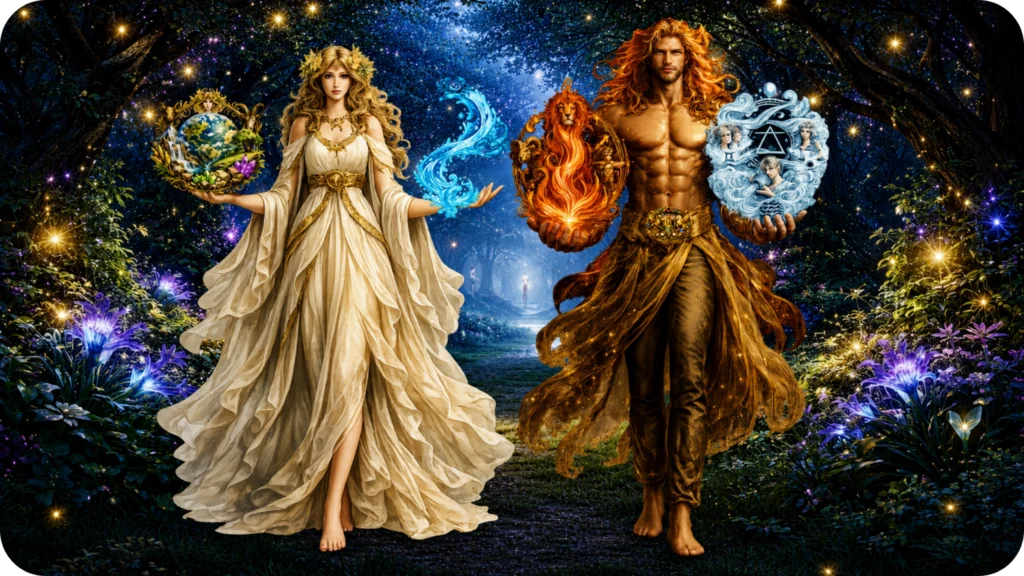
The Elements, the Polarities of Energy and Temperament
In Part I we looked at how the elements in astrology are divided into two polarities – masculine (Fire and Air) and feminine (Earth and Water), or respectively yang and yin, or extraverted and introverted, and how they determine our temperament. We also saw how the elements are connected to the humoral theory of the ancient Greek physician Galen (2nd century AD), developed on the basis of the earlier physiological theory of Hippocrates concerning the four bodily fluids (humors) – blood, phlegm, black bile, and yellow bile, as well as my slight disagreement with the way the correspondences between the elements and the humors are assigned. Thе theory classifies people according to which fluid predominates.
In brief, the main needs of the elements are:
- Fire – spark, movement, and direction.
- Air – continuous movement of thought, information and communication.
- Earth – stability, predictability, and consistency.
- Water – emotional depth, emotional connection, and emotional experience.
We also discussed the meaning and psychological motivation of the masculine elements – Fire and Air. Now let us turn our attention to the feminine elements – Earth and Water.
Qualities and Psychological Characteristics of Earth
Earth is the hardest, most stable, and most static of the four elements. It is connected with the material, the tangible, and the real — with that which can be seen, touched, verified, and transformed into form. The Earth element has a natural drive toward security, stability, and durability. It does not hurry, because its strength lies in patience, consistency, and the ability to build gradually. This is precisely why Earth is the element of realization and materialization — it transforms an idea, a potential, or a talent into something concrete and lasting.
Psychologically, Earth relies on sensory perception and immediate reality. An Earth person prefers to deal with what is actually in front of them rather than with the abstract “what could be.” They observe, assess their resources, and look for a practical way to use them. Therefore, caution, planning, foresight, habits, and rituals are natural tools for creating security. In its healthy expression, this stability allows a person to endure, refine, maintain, and bring what they have started to completion. Earth has the ability to withstand for a long time, to work with reality as it is, and gradually improve it.
The same need for security, however, can turn into fear of change, inertia, and encapsulation. When an Earth person turns their habits, beliefs, and rules into absolute laws, stability becomes stubbornness, control, and resistance to the natural flow of life. Patience can then become stagnation, practicality can become limitation, and the pursuit of security can become an obsessive need for everything to be predictable and controllable. The shadow of Earth is precisely denying reality when it does not correspond to the internal structure that has been created. The task of the Earth element is not to abandon stability, but to preserve the ability to adapt, so that stability does not turn into stagnation.
| Positive Manifestations | Negative Manifestations |
| • Stability • Reliability • Practicality • Patience • Consistency • Foresight • Endurance • Realism • Materialization • Ability to build | • Inertia • Stubbornness • Conservatism • Encapsulation • Fear of change • Excessive control • Fixed beliefs • Obsessiveness • Skepticism toward the unknown • Denial of reality |
Modalities:
🌱 Capricorn – cardinal

🌱 Taurus – fixed
🌱 Virgo – mutable
Qualities and Psychological Characteristics of Water
Water is the element of feelings, the unconscious, memory, and emotional connection. It is moist and cold — moisture blurs boundaries and connects, while coldness slows down and directs inward. Therefore, Water does not necessarily react quickly or visibly: it first senses, absorbs, and experiences, and only then finds a way to express itself. It moves along the path of least resistance, goes around obstacles, and gradually dissolves them. Psychologically, this represents the ability to adapt to the environment, sense what is invisible, and connect with another person beyond words.
The primary drive of Water is unity — to overcome separation and merge again with that which it experiences as its own. This is why it is associated with closeness, belonging, love, compassion, and empathy. A Water person often picks up on the moods and atmosphere around them, even when no one says anything. Yet this very lack of clear boundaries can cause them to identify too strongly with others and lose contact with their own needs. Water also carries a strong connection to the past — personal, ancestral, and collective memory, with that which is not fully conscious but continues to live within us.
In its balanced expression, Water is deep, intuitive, compassionate, and capable of healing through acceptance and emotional support. It does not seek to control everything through logic, but to feel the essence of the experience. But when there is too much Water or when it remains stagnant, its energy can become stuck: suppressed feelings, dependency, idealization, resentment, depression, or loss of personal boundaries. Therefore, Water does not so much need to be “cleansed” of its feelings as to be given the time for them to settle, become conscious, and be integrated. Just as water finds its way to the sea, the psyche seeks its way back to wholeness.
| Positive Manifestations | Negative Manifestations |
| • Empathetic • Intuitive • Compassionate • Accepting • Connecting • Adaptive • Deep • Nurturing • Transformative • Spiritual | • Dependent • Boundless • Passive • Suppressed • Resentful • Idealizing • Self-sacrificing • Symbiotic • Stagnant • Depressive |
Modalities:
🌊 Cancer – cardinal

🌊 Scorpio – fixed
🌊 Pisces – mutable
In the following article, we’ll talk about the balance between the elements and what happens when one or more elements are lacking, or when we have only one planet in an element.