
The Elements in (Im)Balance
Classifications of the Elements
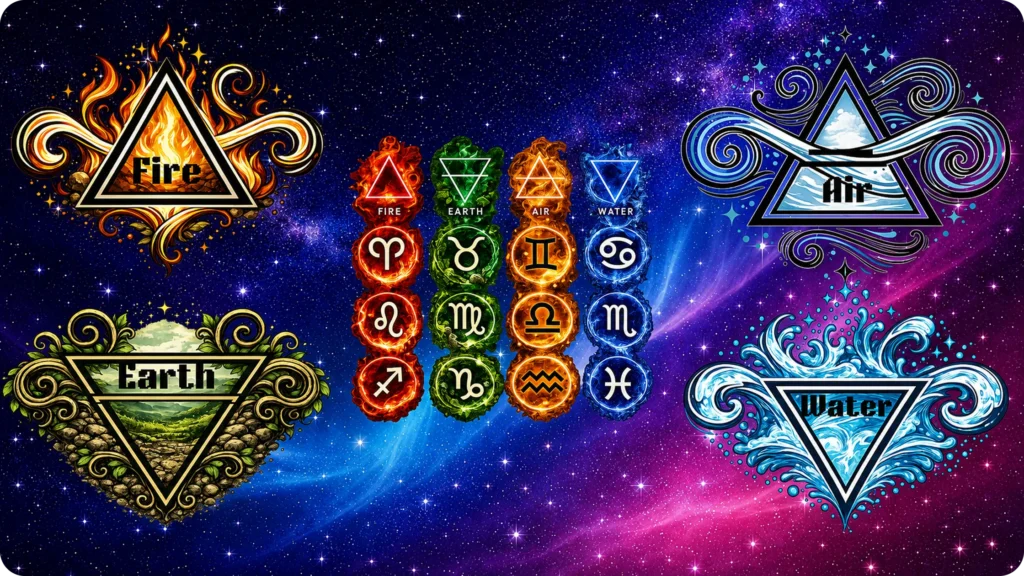
In the previous two articles (Part I – Fire and Air and Part II – Earth and Water), we saw that the elements are one of the fundamental building blocks of astrology in any chart. Western astrology works with the four natural elements – Fire, Earth, Air, and Water. These elements are divided into two complementary pairs – Fire works well with Air, while Earth works well with Water. The elements can also be understood as two polarities – masculine and feminine, or respectively yang and yin, or extroverted and introverted.
The Elements in (Im)Balance
Each element possesses certain qualities. Each element possesses certain qualities. The elements are present in different combinations and degrees in every person. Our personal configuration may be predominantly harmonious and create little inner friction, or it may be quite challenging, leaving us feeling torn by constantly conflicting impulses and unable to find inner peace and stability. The most harmonious charts have all four elements in relatively balanced proportions, although every chart has its own internal struggles. But what happens when there is an imbalance between the elements?
Types of Elemental Imbalance
- A large concentration of planets in one element – the characteristics of this element are strongly emphasized and may even become exaggerated, to the point that we become so blinded by them that we fail to realize we are out of balance.
- A missing element – we may respond to it in a polarized way. A person may be very capable in the domain associated with this element and use its qualities naturally, yet express them in a way that is unusual or atypical for the element itself. We may also experience a whole range of feelings toward it – attraction, rejection, obsession, dependence, or a need for compensation. Consciously or unconsciously, we may avoid or seek out people, situations, environments, or professions that bring us into direct contact with the qualities of this element.
- A single planet in an element – very often, this planet may carry disproportionate weight in our lives because it has to carry the entire element on its own. We may even overdevelop and overuse its qualities because we feel deficient or insecure in that area. In some cases, a person may work so extensively on this planet that, at some point, they appear to be much more proficient in the qualities associated with the entire element than people with several planets in it. I have such a configuration myself, and one of my long-standing struggles has precisely been to find solid ground beneath my feet in this area of life, let go of the feeling that I am constantly behind, and learn to be more moderate with it rather than making it the focal point of my life or constantly seeking out people who are skilled in this area.
- A suppressed element that we actually possess – in this case, the situation is somewhat similar to that of a missing element. We may become very irritated by people who express it, or unconsciously envy them, while in reality, the element is already a part of ourselves but has been suppressed for one reason or another.
Missing Elements
- Fire – when Fire is missing, a person may find it more difficult to turn an inner impulse into action. A lack of spontaneity and initiative may keep them within familiar territory and limit their willingness to experiment and create. Over time, this can diminish their sense of drive and vitality, as well as their enjoyment of life and desire to seek new horizons, meaning, and opportunities for personal or creative fulfillment.
- Earth – when Earth is missing, there may be a disconnect from the practical and material side of life. A person may find it difficult to ground themselves, plan ahead, and consistently work toward improving their circumstances. This may be accompanied by a lack of patience, resilience, and perseverance, making it more difficult for rich ideas and creative potential to be realized and materialized. The same difficulty with grounding may also manifest as a weaker connection with the body and the need to care for it practically.
- Air – when Air is missing, a person may have difficulty trusting reason and logic, which can affect both communication and their ability and willingness to engage with new information and different perspectives. Being closed off to new contacts and ideas may cause change to be perceived as a threat rather than a natural path toward growth, limiting the desire to explore broader horizons.
- Water – when Water is missing, a person may have a weaker connection with their own emotional nature and keep their feelings at arm’s length, making empathy and deeper emotional connection with others more difficult. Suppressed emotions, however, do not disappear – they may accumulate and manifest suddenly and intensely, while the inner emotional world remains strong and rich, particularly in dreams. Thus, apparent objectivity and composure may coexist with a deep but difficult-to-access sensitivity.
Contradictory Temperament
Some of the most difficult charts belong to people whose temperament is shaped by conflicting characteristics. We may feel as though there are two completely different selves within us, without this necessarily meaning that we have any severe psychological disorders. At different stages of our lives, we may even reject one element because we feel that it interferes with the other’s wellbeing, or alternate between the two because we cannot find a way to integrate them so that they work for us rather than against us. Let us take a brief look at what may happen with the different combinations.
Fire and Water
- Creative expression – it endows a person with the ability to understand life beyond a purely rational, orderly, and predictable framework and to develop a deep awareness of the invisible layers of existence. This is because the person has felt and experienced much of what cannot be contained within the boundaries of the rational and the sensory. At the same time, they have learned to use feeling as fuel for action, while action becomes a means through which feeling can find expression.
- Obstructed expression – Fire and Water need a vessel through which the emotional dimension and the vision of what could be can find an external outlet. These experiences and forms of knowing may remain deeply hidden within the person, leaving them unable to find a way to express them and connect with the outside world. There may also be enormous difficulty regulating the intensity of experiences or a profound conflict between sensitivity and the desire to act.
Fire and Earth
- Creative expression – Earth can take the images and vision of Fire and turn them into something concrete and tangible.
- Obstructed expression – inner tension between vision and impulse on one side and materialization on the other, or alternating between phases in which we feel disconnected from reality and from our bodies and phases in which we become highly conscious of the presence and significance of matter, and may even begin to focus excessively on the body. Earth can “weigh down” Fire, pulling it downward and disconnecting it from its vital force, creating a sense of premature death and meaninglessness. Fire may fail to find a fitting existing form for what it wants to express.
This is also my personal configuration, and I have gone through different phases and variations of attempts to reconcile these two raging hurricanes – one screaming and wanting to sweep everything out of its path because it cannot find a way to emerge in a form that does not distort it, while the other is terrified precisely that it will be swept away by something immensely powerful that it does not understand and does not know how to handle.
At times, I felt completely merged with one element, then with the other; at other times, I was an outside observer, watching them try to communicate and find their way toward one another. Yet in many cases, they simply could not do it. Fire had so much to express and create, while matter was so dense and slow, vastly imperfect from Fire’s point of view, and so energy-consuming and obstructive that Fire simply gave up again and again on doing anything at all. And yet there was a deep need to embody itself in something it could give to the world and leave behind.
Air and Water
- Creative expression – Water gives Air depth and human substance, while Air gives Water language and perspective. This allows a person to transform a difficult-to-grasp inner experience into something that can be understood and shared.
- Obstructed expression – overanalyzing feelings, a disconnect between what a person feels and what they are able to say, difficulty with emotional immediacy – distancing themselves when emotions become too intense, or talking excessively about an emotion instead of actually feeling it.
Air and Earth
- Creative expression – a person who is capable of doing something rather rare – translating an idea into a functioning form. Not simply having an idea, and not simply doing something practical, but understanding how an idea can be structured so that it functions sustainably in reality in the long haul.
- Obstructed expression – a person may move between the concrete and the abstract but struggle to decide when to stop thinking and start acting, or the other way around – they begin creating something, but then Air sees ten more possibilities and starts changing it, so that in the end, nothing is ever finished. Or a person may build something stable and then begin to see how it could be done differently. If Air dominates, this may manifest as a difficulty in keeping one form in place long enough for it to become established. If Earth is stronger, it may “ground” Air too much, so that ideas must constantly justify their practical value.
Conclusion
In conclusion, I would say that all elements have both their light and shadow sides, just as every archetype has its own place, function, and significance within the universal whole. There are no better or worse elements, signs, or planets. There are constructive and destructive expressions, as well as complementary and conflicting configurations. With a little more self-observation, the help of a friend or professional, research, and trial and error, everyone can discover what works best for them in the long run. This allows us to invest as little energy as possible in managing problematic areas and free up more space for joy, pleasure, and growth in others.
In conclusion, I would say that all elements have both their light and shadow sides, just as every archetype has its own place, function, and significance within the universal whole. There are no better or worse elements, signs, or planets. There are constructive and destructive expressions, as well as complementary and conflicting configurations. With a little more self-observation, the help of a friend or professional, research, and trial and error, everyone can discover what works best for them in the long run. This allows us to invest as few resources as possible as possible in managing problematic areas and free up more space for joy, pleasure, and growth in others.